Hardware-Rooted Asset Identity for Ferrous Surfaces
Tessera is a patent-pending passive NFC asset identity platform designed for ferrous environments where conventional labels, QR codes, adhesive tags, and basic NFC approaches struggle. The platform combines magnetic attachment with a protected physical-digital identity workflow, allowing assets to be tapped, verified, and logged without batteries, always-on radios, or a vendor-owned tracking cloud.
Conventional Asset Identity Fails on Metal
Labels peel and fade. QR codes need line of sight and clean surfaces. Standard NFC tags detune when placed directly on steel — eddy currents kill the antenna. So-called "on-metal" tags use ferrite to manage this, which works until you add a strong magnet.
Magnetic Retention Creates an NFC Design Challenge
Many NFC approaches can work on metal only under limited conditions. When strong magnetic attachment, steel substrates, environmental exposure, and operational handling are combined, read reliability and physical durability become harder to preserve. Tessera is designed around that combined operating problem rather than treating magnetic retention and NFC performance as separate features.
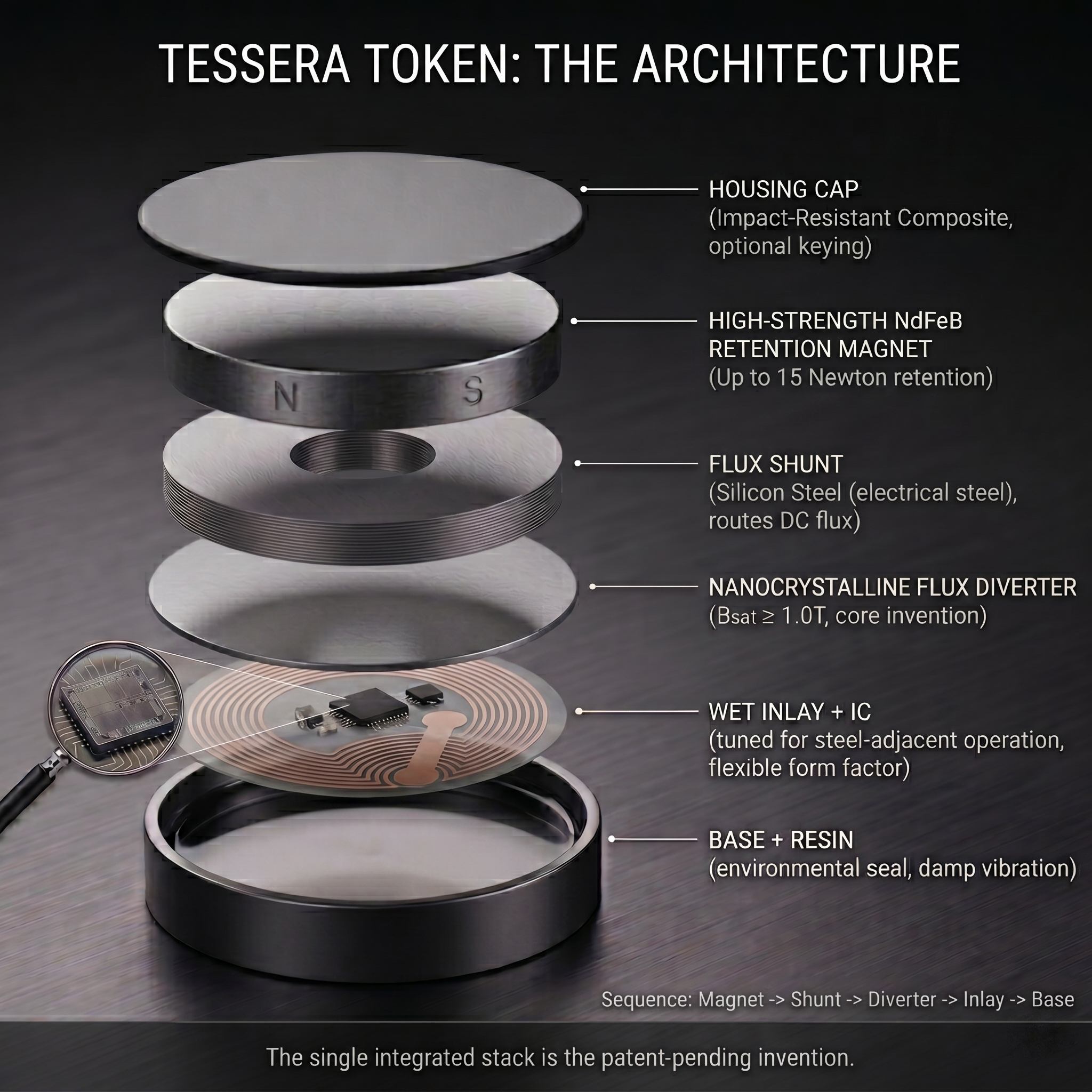
-
Ruggedized housingApplication-specific enclosure design for protecting the token, supporting handling requirements, and matching the physical environment.
-
Magnetic attachmentRemovable attachment to ferrous assets without drilling, welding, or permanent adhesive. Retention strength is selected for the application and threat model.
-
Magnetic management layerInternal magnetic management features help preserve NFC behavior when the token is attached to steel or other ferrous surfaces.
-
Patent-pending RF management architectureThe protected architecture is designed to support passive NFC communication in steel-heavy environments while maintaining magnetic attachment.
-
Passive NFC identity layerNFC identity options can be configured for simple consumer workflows or stronger authenticated workflows depending on the product series and buyer requirements.
-
Sealed base structureBase and encapsulation features protect geometry, support durability, and help adapt the token to the operating environment.
The protected invention is the integrated system approach: magnetic attachment, passive NFC operation, ferrous-surface use, and physical-digital identity workflow in a single deployable token architecture. Detailed implementation parameters are maintained as controlled company background data.
Both series share the same platform thesis: a passive, magnetically attached token that connects physical assets to digital workflows. Product configuration varies by application, assurance level, and operating environment.
Consumer & Gaming
Passive HF NFC identity tokens for tabletop gaming, hobby collections, and consumer applications. Magnetically retained to metal game boards, terrain, and storage cases. Simple read/write for character data, scenario information, and collection management.
Industrial, LOTO & Defense
Hardware-rooted asset identity for industrial equipment, LOTO programs, depot maintenance, supply chain integrity, and defense logistics. Designed to support clone-resistant and replay-resistant workflows when deployed with appropriate authenticated NFC configuration, key management, and backend validation.
The Ordnance Series is designed to move beyond static UID-only identity. In an authenticated deployment, each tap can generate a cryptographically verifiable message that is checked by a backend system before the event is recorded. This makes the workflow stronger than simple tag lookup, while still depending on proper enrollment, key management, reader behavior, and backend validation.
| Property | Conventional On-Metal Tag | Tessera Forge Series | Tessera Ordnance Series |
|---|---|---|---|
| Magnetic retention on steel | No — adhesive or standoff only | Yes — application-specific magnetic retention | Yes — application-specific magnetic retention |
| Reads under magnet bias | No — ferrite saturates | Designed for ferrous-surface NFC operation | Designed for ferrous-surface NFC operation |
| Authentication model | UID only — static, clonable | Basic NFC identity — not intended for authenticated workflows | Authenticated NFC event model |
| Clone resistance | None | None | Hardware-backed authentication option |
| Replay resistance | None | None | Counter / transaction validation when enabled |
| Event assurance | None | None | Cryptographically verifiable event record |
| Tamper evidence | None | Physical evidence on removal | Physical evidence and optional tamper-aware configurations |
| Mechanical tamper resistance | None | Optional interlock | Optional interlock — twist-lock, detent, or tool-required release matched to threat model |
| Power | Passive HF | Passive HF | Passive HF — no batteries, no maintenance |
| Backend model | Vendor SaaS — third-party ledger | Your Google or Microsoft tenant | Verified events routed to customer-owned systems |
LOTO & Safety Compliance
Each LOTO inspection tap generates an authenticated NFC event — timestamped, cryptographically verifiable when authenticated workflows are enabled, written to your EAM. The read counter flags gaps. A missed inspection shows up as an absence in the record, not a disputed paper log. The token on the breaker is passive; it powers up when tapped and goes dark when you walk away. No batteries in the token and no always-on radio required.
Defense Depot & Maintenance
Hardware-rooted asset identity for vehicles, equipment, tools, and calibrated instruments in depot and field maintenance environments. Removes the adhesive and drill-hole limitations that prevent conventional RFID tagging on ferrous DoD assets. Compatible with existing NFC-capable mobile devices and reader infrastructure.
Supply Chain Integrity
Authenticated identity workflows for ferrous containers, crates, and equipment throughout the defense supply chain. Verified event logic can help verify at receiving that the presented token matches the expected authenticated identity record. Supports DoD supply chain integrity requirements where UID-only tags are insufficient.
Tool Control & Calibration Tracking
Authenticated identity for steel tooling in manufacturing, aerospace, and defense maintenance. Each tool tap generates a verifiable event — check-out, check-in, calibration touch — with transaction sequencing that can help flag gaps or unexpected event patterns when backend validation is enabled, regardless of whether the tool stayed on the correct asset.
Hardware-Backed Verification Model
Authenticated NFC deployments can use hardware-backed keys and backend verification to improve resistance to cloning and replay. Security outcomes depend on implementation choices, enrollment controls, reader behavior, and backend policy enforcement.
Passive — No Batteries, No Subscriptions
Power is harvested from the reader field during each tap. Dormant tokens consume nothing, fail nothing, and require no maintenance. Authentication events occur on demand, not continuously. No always-on radio. No subscription tracker. No battery replacement schedule.
Your Ledger, Your Rules
Verified tap events can be routed directly into your Google or Microsoft tenant. No Aegidis intermediary. No required third-party platform intermediary. Your audit trail lives where your other records live, managed by people who already have clearance to manage it. If you ever stop using Tessera, the data stays with you.
Layered Physical Security by Design
Threat model determines configuration. Base configurations focus on magnetic retention and physical evidence of handling. Additional mechanical or tamper-aware options can be selected for elevated environments. The platform is designed to adapt by application.
Best Fit
- Ferrous-asset workflows where adhesive/QR solutions fail reliability checks.
- Programs requiring verifiable tap events in customer-owned systems.
- Pilot teams that can define one clear workflow and success metric.
Not a Fit (Right Now)
- Use cases needing always-on GPS or continuous live location tracking.
- Buyers expecting plug-and-play deployment without workflow enrollment steps.
- Programs that cannot support even light pilot integration effort.
Sample kits, pilot evaluations, and integration discussions for both the Forge Series and Ordnance Series are available for qualified buyers. Bring your use case — we'll tell you which configuration fits.